
Benefits of the Sauna
Sauna: More Than Just a Good Sweat

HEAL • MOVE • CONNECT
You get hot. You sweat. You slow down.
On the surface, the sauna is pretty simple. But underneath that experience, your body is making a number of physiological adjustments in response to heat.
Your heart rate increases. Blood vessels expand. Circulation changes. Your body works harder to regulate its temperature. And once you step out and begin cooling down, another shift starts to happen.
Used appropriately, sauna can complement an active lifestyle by supporting cardiovascular health, recovery, relaxation and sleep.
It isn't a replacement for exercise or good recovery habits.
Think of it as another useful tool.
MOVE: Challenge Your Cardiovascular System Without Moving
As your body temperature rises in a sauna, your cardiovascular system responds.
Blood vessels near the skin dilate to help dissipate heat. Blood flow increases and your heart rate rises—creating a cardiovascular demand even though you're sitting still.
This response is one reason sauna and other forms of heat exposure are sometimes described as passive heat therapy.
There is some interesting research behind this.
A large Finnish study published in JAMA Internal Medicine followed more than 2,300 middle-aged men for roughly 20 years. More frequent sauna bathing was associated with lower rates of sudden cardiac death, fatal coronary heart disease and fatal cardiovascular disease.s
Combined with research examining blood pressure, circulation and vascular function, it provides an interesting picture of how regular heat exposure may complement an active lifestyle.
Put it into action
If you're new to sauna, start conservatively with approximately 10–15 minutes at a comfortable temperature.
As your heat tolerance develops, you can gradually work towards longer sessions.
More isn't automatically better. Heat is already a physiological stressor.
You don't need to turn recovery into another competition.
FEEL: Training, Heat and the Recovery Response
A good workout is intentionally stressful.
Heart rate increases. Muscles generate force. Energy demands rise and your nervous system increases its output to help you perform.
Training also triggers hormonal and cellular responses as your body reacts and eventually adapts to that stress.
One of those responses involves growth hormone (HGH).
Exercise can temporarily increase circulating growth hormone. Interestingly, heat exposure can also stimulate an acute growth-hormone response.
Older experimental sauna research has demonstrated significant increases in circulating growth hormone following heat exposure, although the size of that response can vary considerably with temperature, duration, age and individual heat tolerance.
So does jumping into a sauna after training amplify your workout?
That's where we need to be careful.
Research examining exercise followed by traditional sauna has found that exercise produces a significant hormonal response, but adding sauna did not necessarily increase that response further.
And a temporary increase in HGH doesn't automatically translate into more muscle or greater strength.
Those adaptations still depend primarily on the quality of your training, progressive overload, nutrition, hydration and—importantly—recovery.
The workout creates the stimulus. Recovery gives your body the opportunity to adapt to it.
Sauna may fit into that recovery process in other useful ways.
Put it into action
After training, allow your heart rate to begin settling and start replacing the fluids you've lost before entering the sauna.
Then think about the sequence:
Train → Hydrate → Sauna → Cool Down → Recover
You created the training stimulus.
Now give your body an opportunity to respond to it.
FEEL: Turn Down the Nervous System
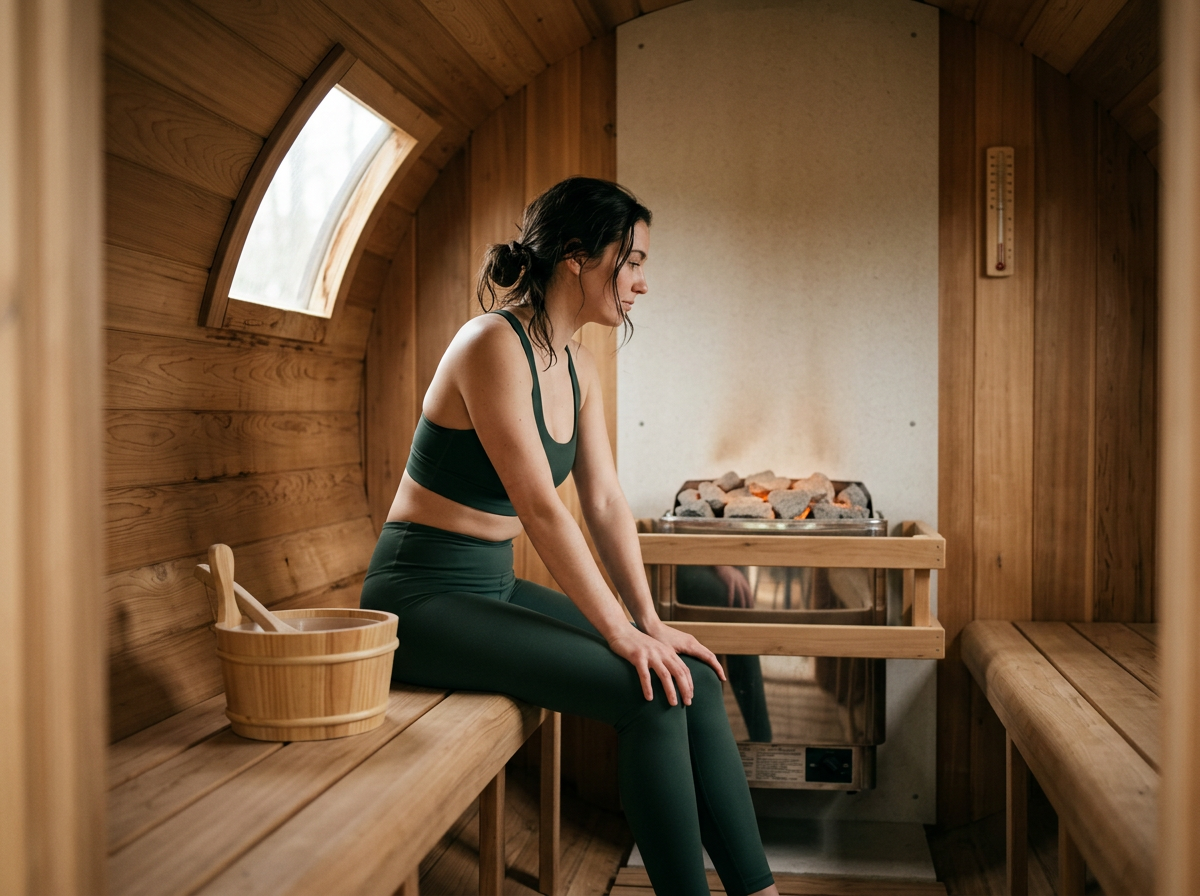
Not every benefit needs to be about performance.
Training, work, screens, deadlines and everyday life can keep us in a constant state of stimulation.
Sauna creates a forced change of pace.
During the heat exposure itself, heart rate and physiological stress increase. The interesting shift happens as you leave the heat and begin recovering.
Research measuring heart-rate variability(HRV) before, during and after sauna found increased parasympathetic activity and reduced sympathetic activity during the cooling and recovery period.
In simpler terms, your body begins moving from "go" toward "recover."
That may help explain the noticeable feeling of calm many people experience after sauna.
Put it into action
Don't make your sauna another task to accomplish.
No phone. No workout. Nothing else you need to get done.
Sit. Breathe. Let yourself cool down afterward.
Give your nervous system a chance to change gears.
FEEL: Heat Can Help Set the Stage for Sleep
That downshift may also help with another essential part of recovery:
Sleep.
Our body temperature naturally changes as we approach sleep, with core temperature beginning to fall.
Heating the body beforehand increases blood flow toward the skin. After the heat exposure ends, the body continues dissipating heat as it cools.
Research into passive body heating has found that heat exposure timed approximately 1–2 hours before bed can shorten the time it takes to fall asleep and may improve sleep quality.
Much of the strongest research in this area has examined warm baths and showers rather than sauna specifically, so we shouldn't assume the protocols are identical.
But the underlying relationship between heat exposure → heat dissipation → falling core temperature → sleep is worth understanding.
Put it into action
For an evening sauna, experiment with finishing approximately 1–2 hours before bed.
Then let the rest of your environment reinforce the message.
Cool down. Hydrate. Dim the lights. Reduce screen time.
Give your body a clear signal that the day's activity is ending.

CONNECT: Sometimes Recovery Means Doing Less
There's another sauna benefit that's difficult to measure in a lab.
It makes you stop.
For 15 or 20 minutes there are no reps to count, kilometres to cover or emails to answer.
Use that time quietly on your own or share it with someone else.
Either way, creating a little space between everything you're doing can be valuable.
Health isn't always about adding more.
Sometimes it's about creating enough space to recover from everything you're already doing.
Who Should Be Cautious With Sauna?
Sauna creates real physiological stress. Heat increases cardiovascular demand and fluid loss, which means sauna isn't appropriate for everyone or in every situation.
Avoid sauna if you are dehydrated, acutely ill or feverish, and avoid combining sauna with alcohol or recreational drugs. These can interfere with hydration, blood-pressure regulation, judgment and your ability to recognize excessive heat stress.
People who experience low blood pressure, frequent dizziness or fainting should be particularly cautious. Heat causes blood vessels to dilate and can further lower blood pressure, especially when standing after a session.
If you have a known cardiovascular condition—particularly unstable heart disease, uncontrolled blood pressure, significant heart rhythm problems or another serious cardiac condition—speak with your physician before using the sauna.
If you are pregnant, consult your healthcare provider before using sauna, as avoiding excessive increases in core body temperature is particularly important.
Certain medications can affect heat tolerance, sweating, heart rate, blood pressure or fluid balance. If you're unsure about a medication you're taking, speak with your physician or pharmacist before adding regular sauna sessions.
Regardless of your health status, pay attention to what your body is telling you.
Dizziness, light-headedness, nausea, unusual weakness, confusion, headache or feeling unwell are signals to get out, cool down and rehydrate.
Heat tolerance isn't something you need to prove.
Start Simple
If sauna is appropriate for you, you don't need a complicated protocol.
Start with 1–2 sessions per week, keep the initial exposure manageable, hydrate appropriately and see how your body responds.
Move your body. Feel the shift. Connect with recovery.
Sometimes taking care of yourself means knowing when to push.
And sometimes it means knowing when to recover.
Research & Further Reading
Cardiovascular Health
Laukkanen T, Khan H, Zaccardi F, Laukkanen JA. Association Between Sauna Bathing and Fatal Cardiovascular and All-Cause Mortality Events. JAMA Internal Medicine. 2015;175(4):542–548.
Exercise, Sauna & Hormonal Response
Rissanen JA, Häkkinen A, Laukkanen J, Kraemer WJ, Häkkinen K. Acute Neuromuscular and Hormonal Responses to Different Exercise Loadings Followed by a Sauna. Journal of Strength and Conditioning Research. 2020;34(2):313–322.
Heat Exposure & Growth Hormone
Kukkonen-Harjula K, Kauppinen K. How the Sauna Affects the Endocrine System. Annals of Clinical Research. 1988;20(4):262–266.
Sauna & the Autonomic Nervous System
Laukkanen T, Lipponen J, Kunutsor SK, et al. Recovery from Sauna Bathing Favorably Modulates Cardiac Autonomic Nervous System. Complementary Therapies in Medicine. 2019.
Passive Heating & Sleep
Haghayegh S, Khoshnevis S, Smolensky MH, Diller KR, Castriotta RJ. Before-Bedtime Passive Body Heating by Warm Shower or Bath to Improve Sleep: A Systematic Review and Meta-Analysis. Sleep Medicine Reviews. 2019.